
cube files
Indexed Cube Lovers Archive

|
cube archivesFAQ GAP filesBlogs
Forum topicsActive forum topics:New forum topics:User loginNavigation |
Discussions on the mathematics of the cube
Does the STOP-cube have a second type of solution?Submitted by ortwin on Mon, 01/29/2024 - 02:52.You might ask: "What the heck is a STOP-cube?" and "Why would I care? Who are you anyways?"
And those are all legit questions of course. My name is Ortwin, I am a long time member of the twisty puzzle forum. Currently I am looking for the answer to question regarding a specific sticker modification of a 3x3x3 cube, but there did not seem to be much interest over there in the question. Walter Randelshofer who is also a member of this forum recommended to post it into this community, and hereby I do. To get an idea what that "STOP-cube" is, you might want to have a quick look at the links to the topics in the twistypuzzle forum: Diameter of the M24 Conway puzzle is 45Submitted by Paul Timmons on Wed, 02/08/2023 - 11:21.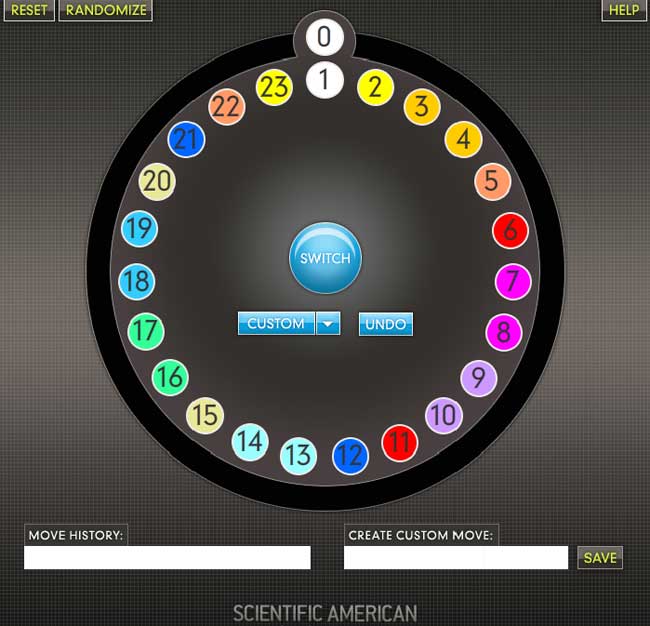 This is a well know puzzle in which there are two moves, one which rotates the central "clock" by one position clockwise or counter-clockwise. The other switches or swaps each pair of numbers with matching colours. I decided to plug these values into GAP to investigate God's number for the underlying group for this puzzle as it still seemed be unknown or undocumented anywhere at least. Feeding these numbers into GAP we get: S := (1,24)(2,23)(3,4)(5,22)(6,11)(7,8)(9,10)(12,21)(13,14)(15,20)(16,17)(18,19); » 3 comments | read more
Streamlined version of the solutions posted here on 22 September 2021Submitted by Peter Tchamitch on Thu, 11/11/2021 - 10:29.It should probably have been stated more clearly in my previous post here on 22 September 2021
that all the proposed sequences and algorithms (in the presentation that was linked to in that post) are designed to solve the WTX and SSX** starting from a situation where one of the 12 solutions of the WT/SS portion of the cube is already in place and the remaining task is to move on from there to the other solutions in order to find the unique solution of the 12 which also results in the characteristic ”valleys” of the WTX/SSX being solved (there is of course a 1/12 chance that the starting solution just happens to be the right one) ** Please note the link at the bottom of the page Proposed solutions to the Wolf Tooth Xtreme and Skewb Star XtremeSubmitted by Peter Tchamitch on Wed, 09/22/2021 - 03:32.This post is a follow-up to my posts of 13 August 2019, ”Bonus Problem”, and 26 September 2019 , ”The latest on the Bonus Problem”
Just to quickly recap: the problem in question was to find the best way to solve the custom hybrid cubes, the Wolf Tooth Xtreme and the Skewb Star Xtreme, which together constituted the Special Prize of the Skewb Star Special Challenge/Competition posted here on 14 June 2019 The top four pages of the presentation here show the state of affairs at the time of the 13 August 2019 post, a state of affairs which was subsequently summarized in the first paragraph of the 26 September 2019 post; in the rest of that post I then outlined, without going into detail, a practical improvement to the previous ”standard method” and added at the end that ”it remains to be shown formally exactly why the improved system described above works” Deficiency minus one presentation for the Tits GroupSubmitted by Paul Timmons on Sun, 05/02/2021 - 04:27.Note that the simple group T (named for Jacques Tits) of order 17971200
has a transitive permutation representation on 2304 points. A general formula for the number of edges in a n-cube is n.2^(n-1) to be found in this extract from "Beyond the Third Dimension" by Thomas Banchoff https://www.math.brown.edu/tbanchof/Beyond3d/chapter4/section05.html It is worth mentioning another source here for a general formula for the number of pieces of different types on a d-dimensional Rubiks' cube A Generalization on the Shamir MethodSubmitted by Jerry Bryan on Sat, 07/18/2020 - 12:14.I have not posted in a very long time, but I have continued to work on ideas for a better program to calculate God's Algorithm for the full cube. The time has long passed where a single desktop class machine could make further progress on the problem as a whole. The search space is just too large for that. Instead, I have been working on ideas for a program that could at least visit all the positions in a single coset no matter how far the positions in the coset are from Start. I have such a program which works, but its performance is not acceptable. Therefore, I'm not going to report anything about it. Instead, I'm going to report on a plan for a new and similar program which I believe will have acceptable performance. I have developed most of the pieces that will be required for this new program, but it will take me a few months to put all the pieces together. The main idea in the new program is very old and is not original with me. The idea borrows heavily from a message to the original Cube-Lovers mailing list by Alan Bawden on 27 May 1987. Alan's message was based on a talk given by Adi Shamir. » 3 comments | read more
Megaminx "cube in a cube" solved in 42 movesSubmitted by cubex on Sun, 03/29/2020 - 14:06.I've found a pattern for the megaminx which is analogous to the "cube in a cube" pattern for the Rubik's cube. It was originally found using a cyclically decomposable process, then many optimizations were applied. The software used to do this includes Twizzle (Tom Rokicki and Lucas Garron) and twsearch. To capture the video the extension nimbus was used on the google chrome web browser.
The sequence of moves in SiGN notation is: BR2 U2' BR2' R2 U' F2 U2' L2 U' BL2 U2 BL2' U' L2' U' F2' U' R2' BR2 U2 BR BL2' L2' R2' U2 R2' U' F2' R2 F2 U' F2' U R2' F2 U R2 U' R2 L2 BL2 BR2 The vid Jakub Stepo´s solutions to the two Skewb Star Competition problemsSubmitted by Peter Tchamitch on Thu, 01/02/2020 - 06:45.For those who don´t know about this competition, please refer to my post of 14 June 2019 entitled "Skewb Star Special Challenge/Competition, with Special Prize", and to my Winner Announcement post of 29 August 2019, in which, as you can see, it was stated that the Special Prize had been awarded but that the challenge itself was to remain open until the New Year; well, the New Year has now arrived, so please find below Jakub Stepo´s solutions to the two competition problems:
Question 1 The latest on the Bonus Problem posted on 13 August 2019Submitted by Peter Tchamitch on Thu, 09/26/2019 - 14:12.The so-called Standard Method referred to in the Bonus Problem post of 13 August 2019 involves
finding the easiest or most convenient Skewb Star or Wolf Tooth solution, depending on how the SSX or WTX respectively were scrambled, and then, unless the characteristic valleys between the corners of the Skewb Xtreme just happen to be spontaneously solved, proceeding from there to the other Skewb Star or Wolf Tooth solutions in an orderly manner until the valleys are observed to be correct. No matter how orderly, this method still involves trial and error, and the Bonus Problem was basically asking for a way to eliminate that somehow. The SSX and WTX have only one The Special Prize of the Skewb Star Special Challenge/Competition of 14 June has been won but the challenge is still openSubmitted by Peter Tchamitch on Thu, 08/29/2019 - 04:43.The winner of the Skewb Star competition posted here on 14 June is Jakub Stepo, who is
a member of the Cube Forum The Special Prize has of course been sent to Mr. Stepo, but I would like to stress that the challenge is still open and that everyone who sends in the correct answers by let´s say 31 December 2019 will have their names published here, as soon as the answers are received After the tentative closing date of 31 December 2019, I was thinking of publishing here all the actual worked solutions that may have been sent to me, and in this connection I can reveal ahead of time that Jakub Stepo´s elegant and powerful solution will certainly be of great interest to Cube Forum |
Browse archives
God's Algorithm Calculations Pollwww.olympicube.com need cube lovers opinion on which cube to produce first olympic cube 6a 83% olympic cube 6b 17% Total votes: 23 Syndicate |
|||||||||||||||||||||||||||||||||||||||||||||||||